10/12/2026
Windpower in Ice and Rock
Wind energy in the Jura Mountains and the Alps holds great potential for winter electricity. However, wind power projects in these regions face the challenges of freezing temperatures and demanding topography. Standard procedures developed for the lowlands quickly reach their limits here.
Switzerland needs winter electricity to ensure its security of supply. Wind energy can make a crucial contribution to this, as typically about ⅔ of the electricity produced by wind turbines in exposed Swiss locations is generated during the winter months. Furthermore, the Swiss Wind Atlas shows that locations in the Alps and the Jura often have high wind potential.
However, realizing projects in the Jura and the Alps is complex. On the one hand, icing conditions pose challenges for wind measurements and for the operation of future wind turbines. On the other hand, complex terrain causes turbulent wind flows, making yield forecasting highly demanding and placing specific requirements on the wind turbines themselves.
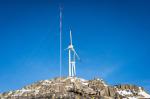
Expertise for complex terrain
Meteotest delivers tailor-made solutions for these challenges. We typically combine mast measurements with LiDAR measurements for vertical extrapolation to hub height. On the measuring masts, heated sensors enable us to record continuous time series of wind conditions over a period of at least twelve months. LiDAR measurements allow the entire rotor area of future wind turbines to be surveyed up to 300 meters above ground level. Deployed in parallel with the measuring mast, they can also cover additional locations within the project area over measurement periods of several months.
Mountainous terrain leads to complex wind conditions characterized by flow separation, rotors, and increased turbulence. These phenomena must be modeled for the entire project area using Computational Fluid Dynamics (CFD) flow simulations so that the locations of future wind turbines can be optimized and reliable yield calculations can be carried out. By combining this with mast and LiDAR measurements, the wind conditions at the site can be characterized in precise detail.
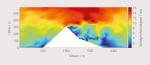 Modeled flow over a mountain ridge: At the highest point, the acceleration is visible, with a wind speed maximum just above the ground. Behind the ridge, flow separation occurs, accompanied by increased turbulence.
Bankable wind assessments according to international standards
Our data-driven approach gives clients confidence in their decision-making: the resulting bankable yield assessment serves as the foundation for determining turbine locations and types, thereby minimizing financial risks. In doing so, we always align our work with relevant international norms and standards, such as IEC 61400, MEASNET, and FGW TR6.
Furthermore, we calculate danger zones using detailed ice throw modeling, and we assess additional project impacts through noise and shadow assessments, as well as visibility analyses. This allows operating modes and warning systems to be optimally planned to protect both people and animals.
Learn more about the challenges of wind energy in the Jura and the Alps in the technical article written by our Head of Wind & Ice, Sara Koller: Complex terrain and cold climate for wind turbines (in German und French).

Your contact
Sara Koller
Head of Wind & Ice
| |